4 min read
LLMs Are the New Compilers: Agentic Engineering, Code Health and Catching AI Slop Before Merge
Nobody reviews compiler output, and in 2026 we start trusting LLMs the same way. How harness engineering, tests and code health make agentic coding safe to ship.
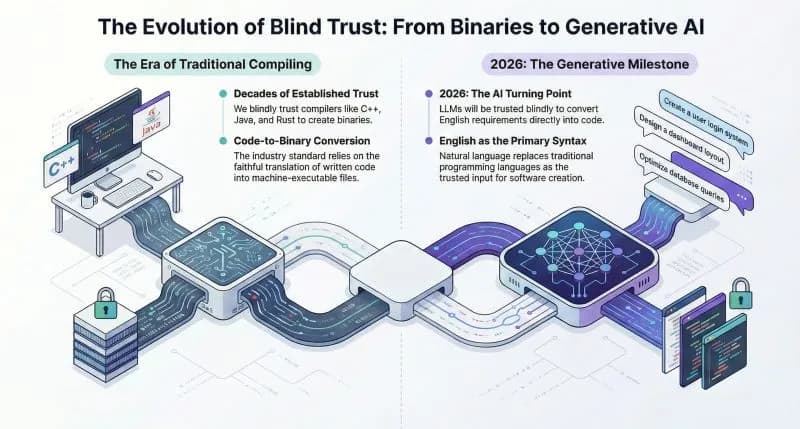
Who of you still reviews the assembly or machine code of your C++, Rust, Go, Java or .NET applications? Nobody. We trust our compilers, transpilers and interpreters blindly. And 2026 is when we start trusting LLMs blindly.
Why? Because LLMs allow us to deliver business value from high-level requirements faster than ever. Even where quality matters more than speed, LLMs are outperforming the best developers.
The compiler analogy, and why understanding still matters
A few months later, Linux and Git founder Linus Torvalds said much the same thing: "I'm 100% convinced that AI is changing programming, but it's not changing the fun."
He also said: "when I see people saying, 'Hey, 99% of our code is written by AI,' I literally get angry, because those same people, I can pretty much guarantee, that 100% of their code is written by compilers. But they never say that."
And the part I think matters most: "People who don't understand the complexity of systems will also prompt systems and write processes that will fail. So, I think you do want to understand how it all works." (The New Stack)
Marc Andreessen put it this way: AI doesn't eliminate programmers, it redefines them. The job is no longer typing code line by line. It is orchestrating coding bots in parallel, arguing with them, debugging their output, changing the spec, and pushing them toward the right result. But if you don't understand how to write code yourself, you can't evaluate what the AI gives you.
That is why being a good prompter is the hottest skill you can have today, not writing syntax. A good prompter is someone who knows what good looks like.
Harness engineering: developers own the what and the why
Ryan Lopopolo from OpenAI shared their Harness Engineering framework. The core idea: "In the AI era, the best engineer isn't the one who writes the most code, it's the one who designs the most resilient environment."
- Developer: defines the what and the why. They own the intent, the business logic, and the architectural landscape.
- AI agent: executes the how. It handles the syntax, the boilerplate, and the documentation.
When developers focus on intent and environment and let agents handle implementation, output goes to 3.5+ PRs per developer, per day. But this shift carries the risk of technical debt growing exponentially. To prevent that, OpenAI advocates a plan-first workflow.
My own two cents from experience: instruct agents to always provide test coverage for whatever they implement or change, and to write comments for files and functions. That enforces high-quality code and ends most of the "AI slop" debate.
You cannot out-prompt a mess
There is a catch. Vibe coding fails significantly more often in unhealthy code. Even in systems considered relatively maintainable, defect risk increases by at least 30% when AI-generated code is introduced. In unhealthy codebases, with high coupling and low cohesion, AI failure rates skyrocket. AI often hallucinates logic or overlooks hidden dependencies a human developer might spot.
The bottom line: you cannot out-prompt a mess. If your architecture is fragile, AI tools act as a force multiplier for technical debt, not a cure for it. Before doubling down on AI velocity, double down on code health. Clean code isn't a nice-to-have anymore. It is the infrastructure AI needs to actually work.
Treat AI like any other dependency
Here is a conversation I see play out in a lot of companies:
CEO: Why is feature X still not live? Clients are churning.
Manager: We're being careful. Want to make sure the code is solid, no AI slop in prod.
CEO: I don't care if it was written by you, by Claude, by a monkey with a keyboard, or by aliens. I care that it works, it's secure, it makes money, and it ships before the competitor does.
Manager: What if something breaks because of AI slop?
CEO: Then build a system that catches slop before merge. Multiple agents, automated tests, style enforcers, security scanners, review agents, whatever it takes. Just stop treating AI as an optional toy and start treating it like any other dependency. You review third-party libs, right? Same energy.
Agentic AI is a mind shift, and that's why most companies are lost.
The flip side also holds. Leaders, POs and managers should use AI tools to validate and verify what software developers and architects are proposing. There are too many cowboys in our industry, and AI makes it much cheaper to check their work.
Use it as a tool, not blindly
AI and LLMs are not like the blockchain hype that leaders fell for a few years back. They have real world use cases across all industries. In software, writing code is mechanical and time intensive, something an AI can do better and faster. The challenge and the opportunity is in properly instructing a machine to reach the outcome you want, design, architecture and business wise.
If you use AI blindly, the joke is on you. If you use it as a productivity tool inside a harness of tests, reviews and healthy code, by all means use it.