6 min read
Be Careful with SQL JOINs: Indexes, the Join Cliff and Join Algorithms
SQL JOINs can become dangerous bottlenecks, even kill your database's stability. Yet the join itself is rarely the problem: indexes, the number of joined tables and query structure decide what it costs.
For years, a persistent myth has haunted engineering teams: the idea that SQL joins are inherently "slow" or "expensive". This fear often drives developers toward fragmented application-side logic or complex subqueries that actually degrade performance. In the world of relational theory, scale is a distraction; indexing is the only truth.
1. Joins aren't expensive, your missing indexes are
The primary driver of join performance is not the number of rows, but the presence of appropriate indexes. Without them, the database is forced to perform a full table scan, shifting your performance profile from a clean logarithmic curve to an exponential collapse. Adding indexes to join columns can reduce execution time by 40% to 52% for common operations like INNER JOIN and aggregations.
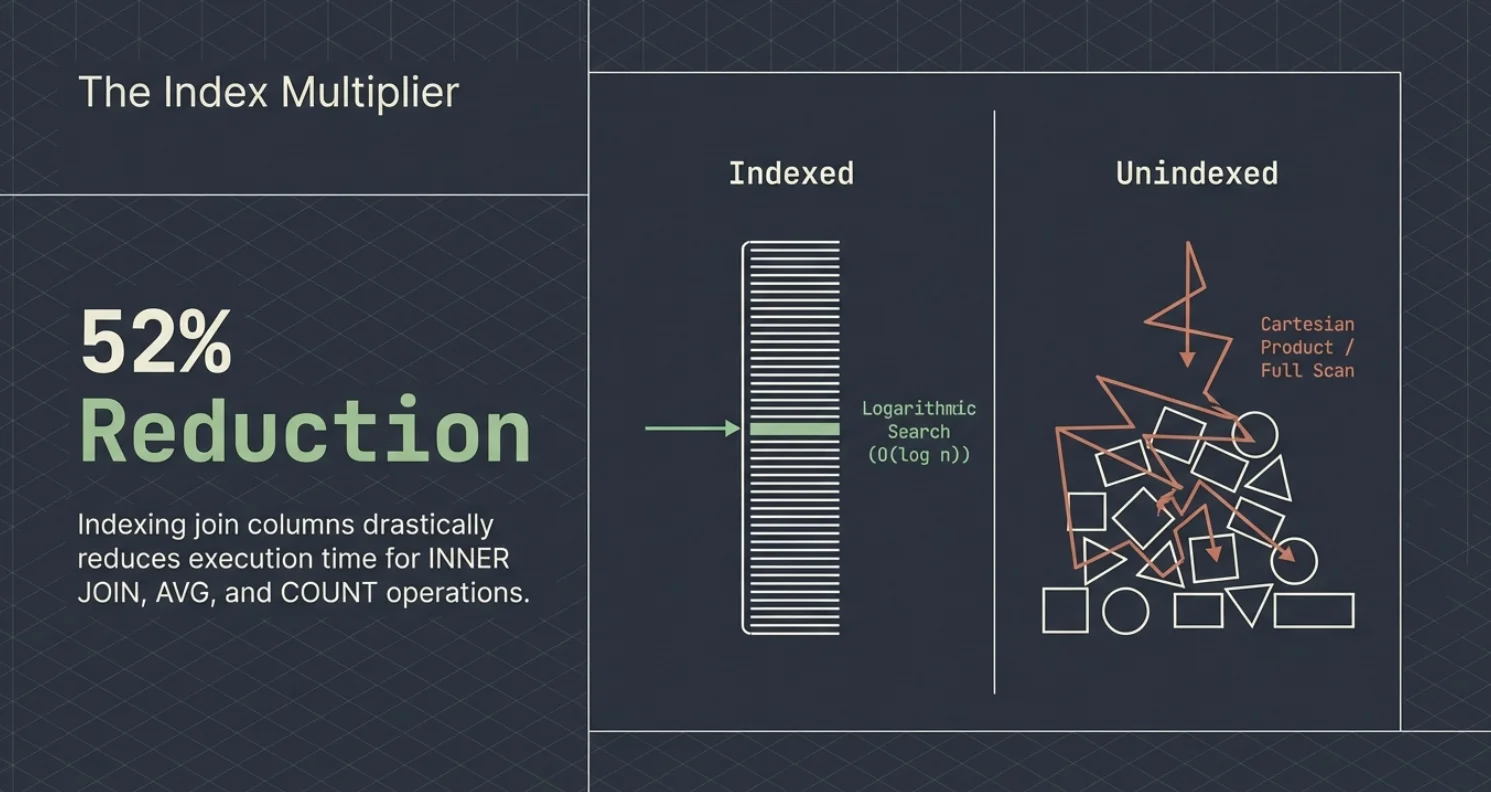
When indexes are missing, the database defaults to a "Cartesian product" approach, essentially comparing every single row in table A against every row in table B. This unnecessary work is why developers often blame the engine when the fault actually lies in the schema design. In an optimized system, joins remain the most surgical way to pull related data across massive datasets.
SQL joins are not inherently "expensive", but their performance cost depends entirely on indexing, data volume and query structure. In a well-optimized relational database, joins are the most efficient way to retrieve related data, often outperforming multiple separate queries or subqueries.
2. The "join cliff" and the factorial explosion
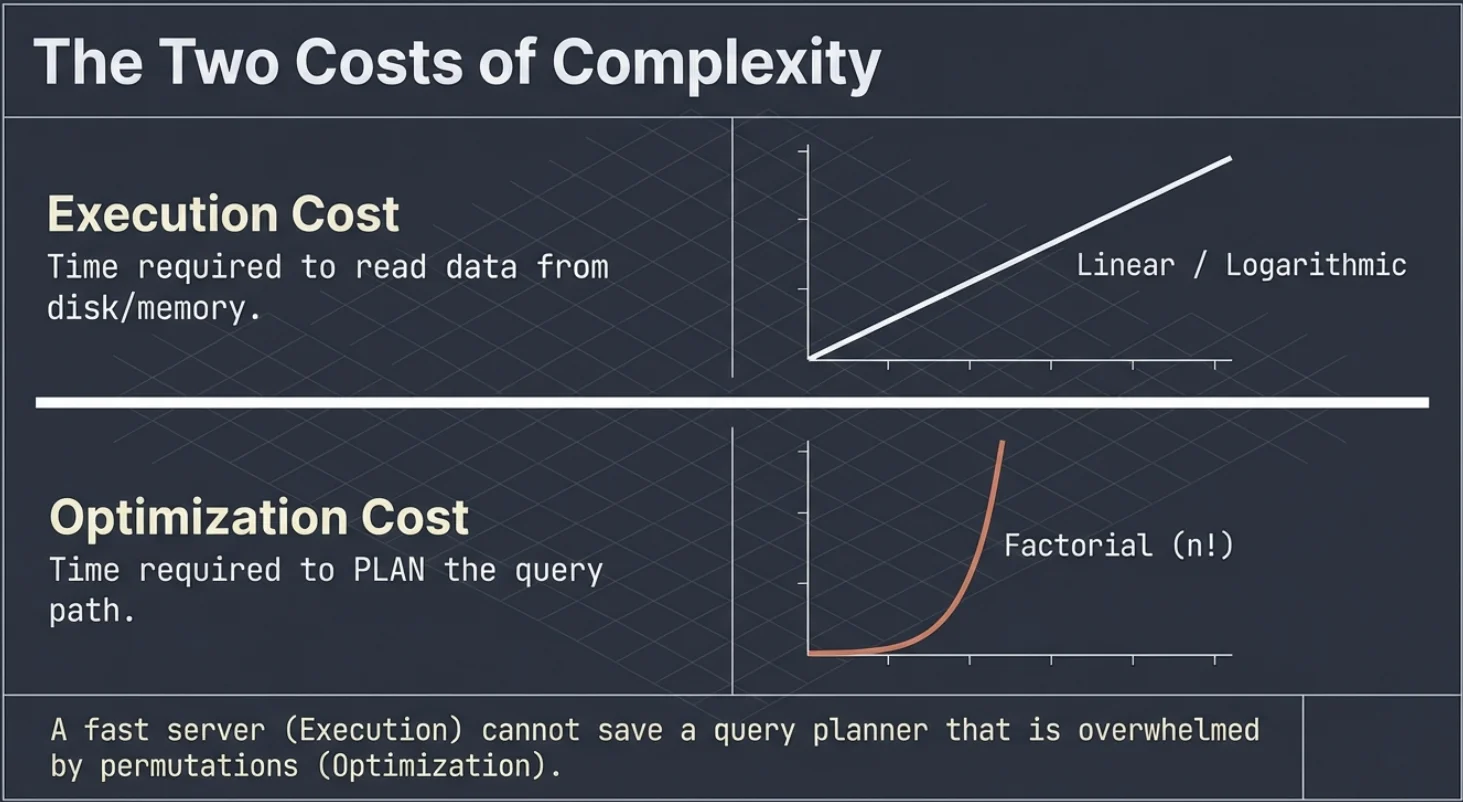
There is a big architectural difference between joining three tables and joining fifteen. While the first few joins exist in a "safe zone" where the optimizer finds the fastest path instantly, you eventually hit the join cliff between 12 and 15 tables. At this scale, the complexity of query planning grows factorially (n!); a 10-table query already presents 3.6 million possible join orders.
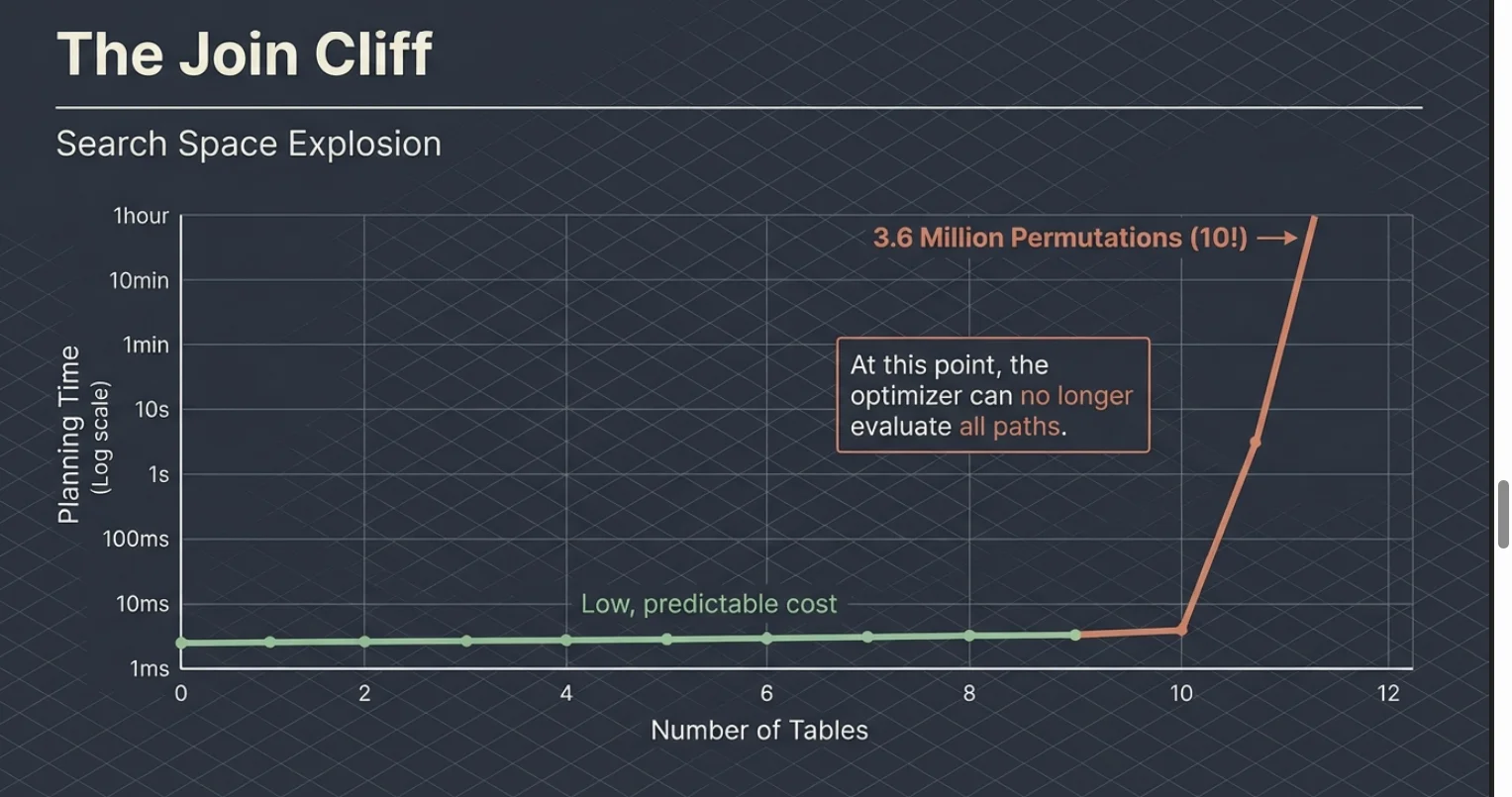
As you enter this "heuristic zone", the database engine may stop seeking the "perfect" plan and rely on a genetic optimizer to start guessing a path. The database often spends more time "thinking" (planning the execution) than actually "doing" (retrieving the data). If you are hitting the 10-table mark regularly, your schema might be crying for a refactor, not just a better optimizer.
3. The 3x performance gap (and the 260x exception)
Benchmarks consistently show that JOINs are the heavyweight champions of data retrieval compared to alternatives like correlated subqueries. In a PostgreSQL study of 10 million records, a LEFT JOIN completed in 4.5 seconds, while a correlated subquery took 14.7 seconds. The join wins because it uses a single-pass algorithm, whereas subqueries often execute once for every single row in the result set.
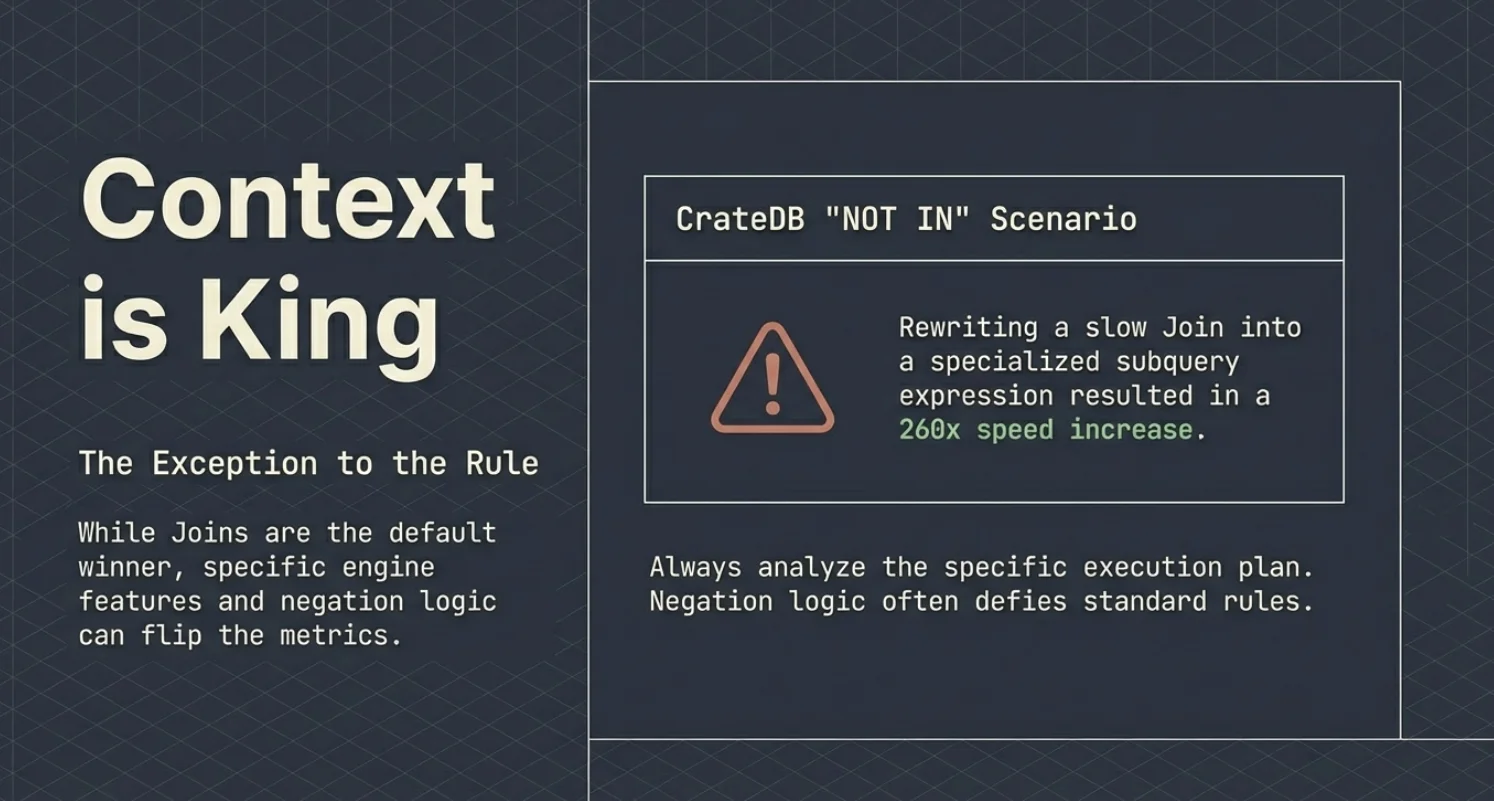
However, database performance is rarely governed by absolute rules, and rare exceptions require constant profiling. A specialized case study from CrateDB found that a subquery was 260x faster than a join for a specific NOT IN scenario. While the 3x advantage is the standard, these outliers remind us that an architect's greatest tool is the execution plan, not just a rule of thumb.
In a PostgreSQL benchmark with 10 million records, a LEFT JOIN was 3x faster (4.5 s vs 14.7 s) than a correlated subquery.
4. Algorithms are the database's "matchmakers"
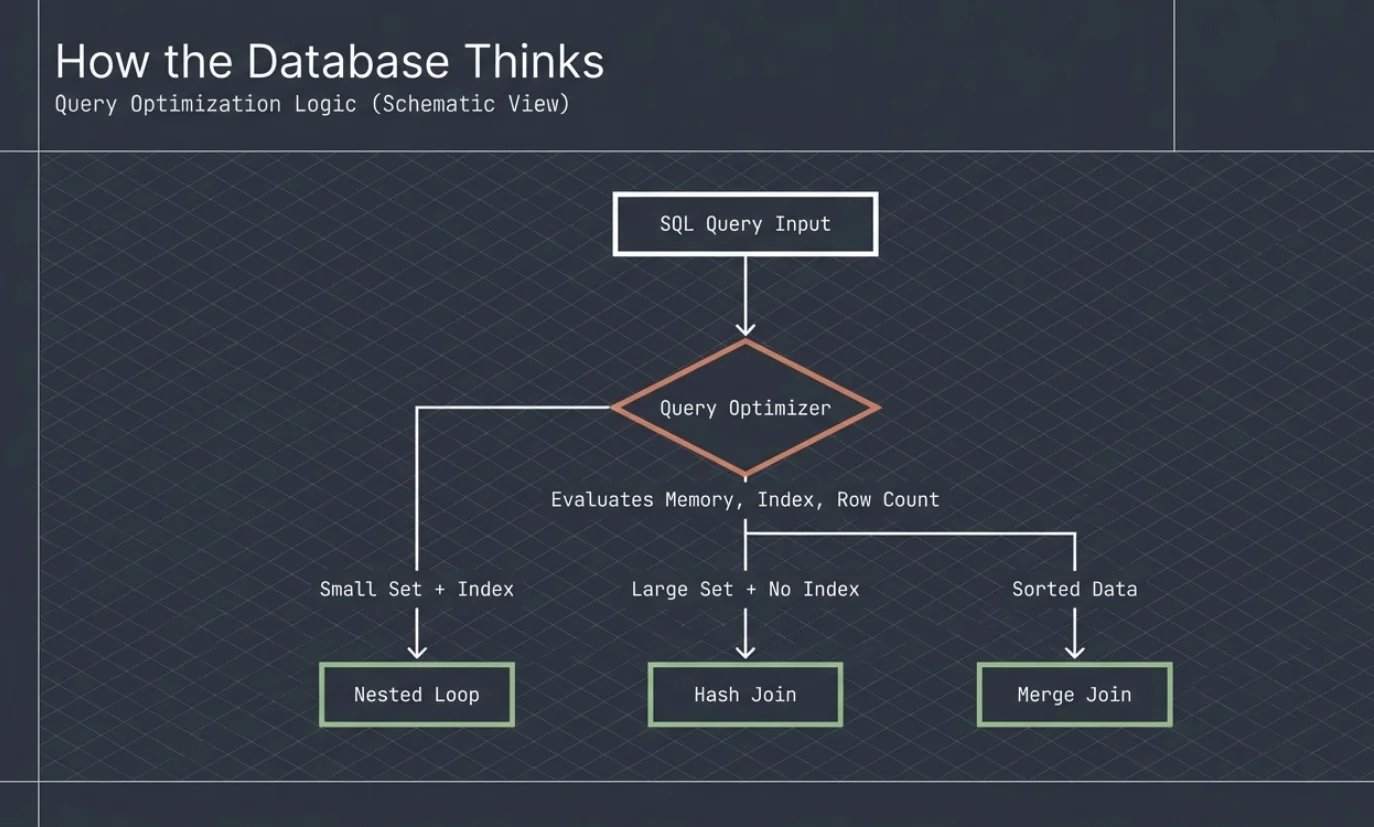
The database engine chooses different "matchmaking" join algorithms based on the data it is processing. Understanding the Big O complexity of these choices helps a developer predict if a query will scale linearly or collapse under load:
- Nested loop join,
O(M × N): highly efficient when at least one dataset is small and indexed, but it becomes very slow for large, unindexed data. - Hash join,
O(M + N): ideal for large, unindexed datasets. This algorithm builds a hash table in memory to provide very fast execution at the cost of higher RAM usage. - Merge join,
O(M log M + N log N): the gold standard for sorted data, such as data retrieved via an index, providing predictable scaling even with massive datasets.
5. The hidden cost of SELECT * and late filtering
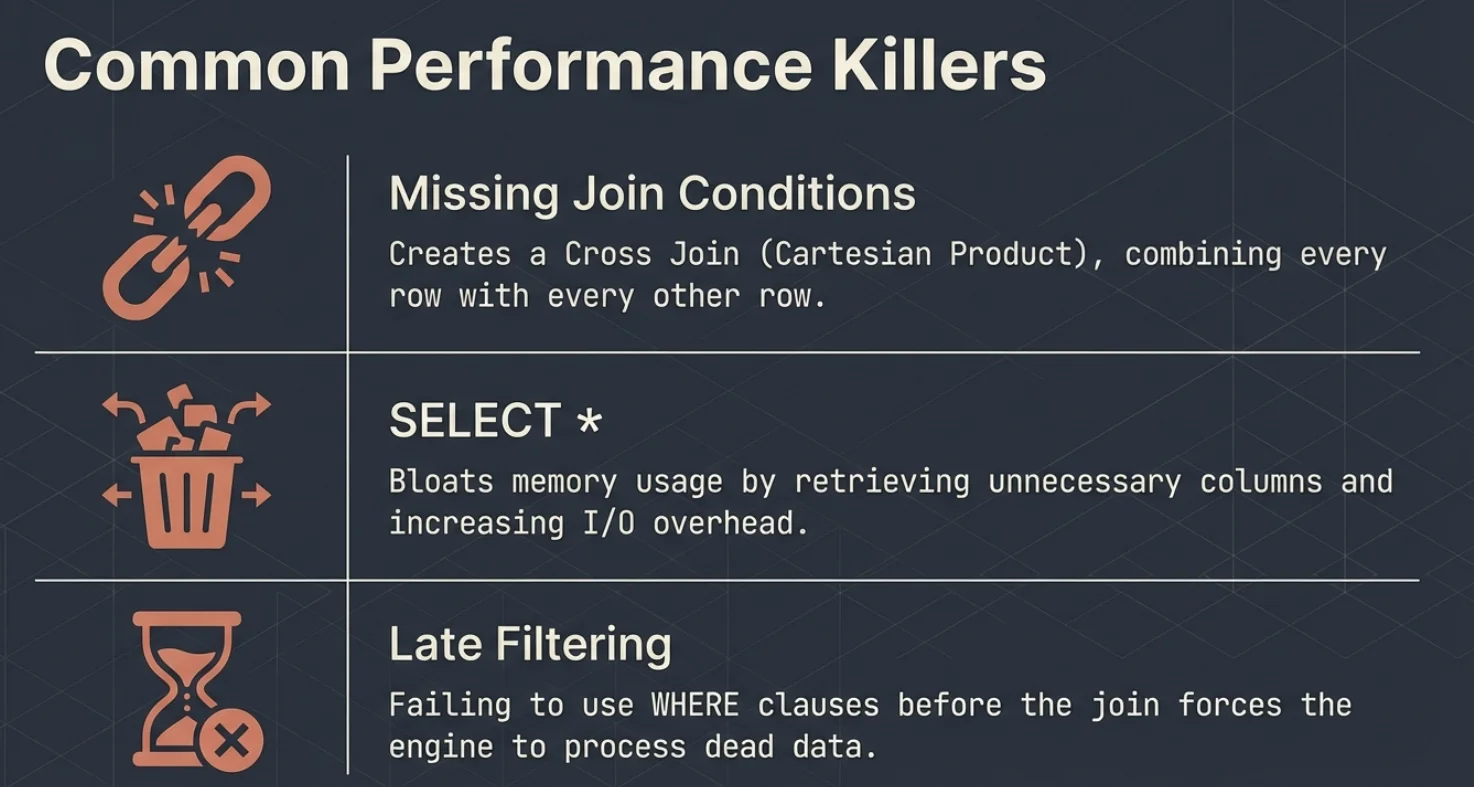
Many "slow joins" are actually self-inflicted wounds caused by poor data hygiene and unnecessary data movement. Using SELECT * instead of requesting specific columns forces the database to move large amounts of data into memory, a cost that compounds with every table added to the join. This overhead is a primary reason why queries that work in development fail under production loads.
It is also vital to distinguish between efficiency errors and structural disasters. Late filtering, failing to use WHERE clauses to restrict data early, forces the engine to process millions of records that it will eventually discard. However, the true system-killer is the cross join, a structural error caused by missing join conditions that combines every row from every table, potentially crashing the entire instance.
Conclusion: beyond the execution plan
Mastering SQL performance requires a shift in perspective from fearing joins to respecting the math behind them. The first five joins in your query are effectively "free" if your indexes are correctly placed and your columns are surgical. But the 11th join might be the one that breaks the optimizer's ability to plan perfectly, leading to a factorial nightmare of heuristic guessing.
The next time your query hangs, will you reach for a subquery, or will you check if your database is stuck in a factorial nightmare?