3 min read
AI and Energy: Why AI Is So Inefficient, Who Wins the Electricity Race, and Orbital Data Centers
AI is wasteful next to biology, and data center emissions could grow 10x by 2030. Why electricity is the real AI race, why solar wins it, and why energy isn't a hard limit.
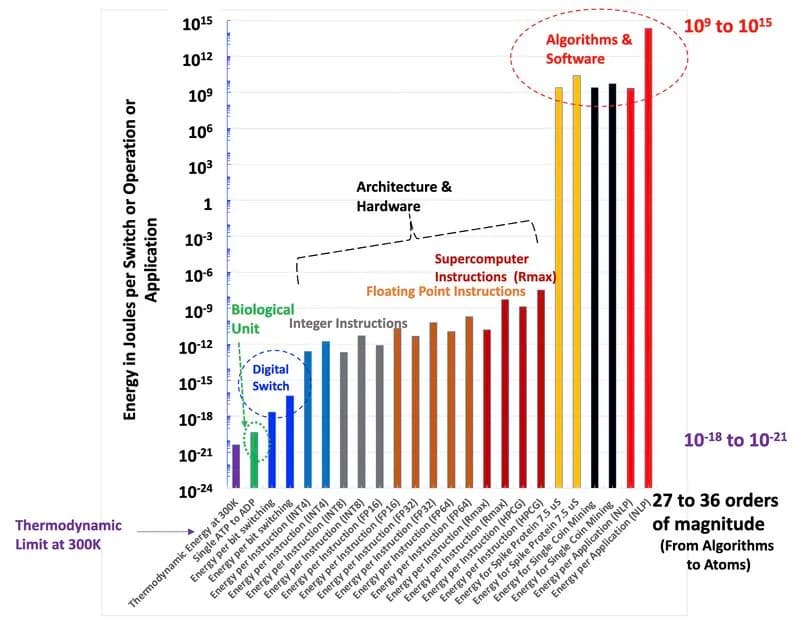
AI and ML are all today's hype, yet the state of AI is extremely inefficient and wasteful compared to biological systems.
AI is wasteful compared to biology
Research by Sadasivan Shankar (SLAC National Laboratory and Stanford Materials Science and Engineering) compares the energy used across the layers of computing against fundamental physical limits (thermodynamics-based) and biological benchmarks (metabolism-based). The gap between them is many factors wide.
One finding stood out to me: the energy used in AI inference over a year is significantly higher than per capita electricity usage in the US, and even higher than the total energy a human spends in a lifetime of seventy-three years.
Key findings from the research:
- Algorithms and software offer the most significant potential for energy efficiency improvements.
- Training AI/ML systems consumes significantly more energy than inference, but inference's cumulative energy use can rival training because it runs for so long.
- System-level energy use remains over four orders of magnitude higher than single transistors, which leaves room for better architecture and hardware design.
- Data access, storage, movement and communication cost more energy per bit than switching.
- Biological systems remain more energy-efficient, operating closer to thermodynamic limits than current computing systems.
I highly recommend the seminar on YouTube and the paper.
Data center emissions could grow more than 10x
Accenture's analysis projects that emissions from AI-driven data centers could grow more than 10x, from 68 million tonnes in 2024 to 718 million tonnes by 2030. That is, if we don't create major innovations in energy systems, chip design, algorithms and AI tooling.
For context: in 2022, global emissions from aviation and shipping were around 800 million tonnes each. AI's future carbon footprint could rival those sectors.
I'm all pro innovation, but at the time my advice was simple: use Google search instead of ChatGPT whenever you can, and your brain, which runs cheaply on cookies and coffee.
Electricity is the real AI race
The demand side is enormous. The increasing electricity demand driven by AI, EVs, industrial electrification and climate goals may require $3 trillion annually by 2030. That is a significant investment opportunity across the electrification value chain: transmission, distribution, energy storage, transport and data centers.
In a world racing for AI dominance, limited by electricity supply, you need to deploy cheaply and rapidly. Nothing comes close to solar panels with battery storage (BESS).
Some numbers worth knowing. Solar panels convert 15-30% of sunlight into electricity, while photosynthesis in plants averages about 3-6%. China is installing around 100 panels per second, about +55 kW every second. The USA is installing around 3 panels per second, about +1.5 kW every second. China's electricity generation capacity compared to the US shows the same trend. It doesn't take an engineer to figure out who will win the AI race.
Energy is not a hard limit
People think energy is a hard limit to scaling AI. At the exponential rate solar and storage are being deployed, it is not. Five years from now, today's deployment data will look flat near zero on the chart.
Orbital data centers
Some of the answers may not even be on Earth. Of the roughly 16,000 active satellites circling our planet, Starlink alone accounts for roughly 10,600, meaning SpaceX operates about two-thirds of all active satellites in orbit.
Starship is set to begin deploying the much more powerful V3 Starlink satellites in 2026. These next-generation satellites feature advanced laser links and are being designed with the potential to host compute, laying groundwork for orbital data centers that could help address the massive energy and infrastructure demands of AI.
Efficiency and abundance, both
The two halves of this story don't contradict each other. AI today is far less efficient than it could be, and the biggest gains are in algorithms and software. At the same time, cheap solar, batteries and new infrastructure can make energy abundant. The countries and companies that push on both will lead.