3 min read
Which Jobs Will AI Replace First? Text, Code, and Why Messy Work Lasts
Jobs that produce text, numbers or code face AI pressure first. Why messy, relationship-heavy work resists automation, and what seniority has to do with it.
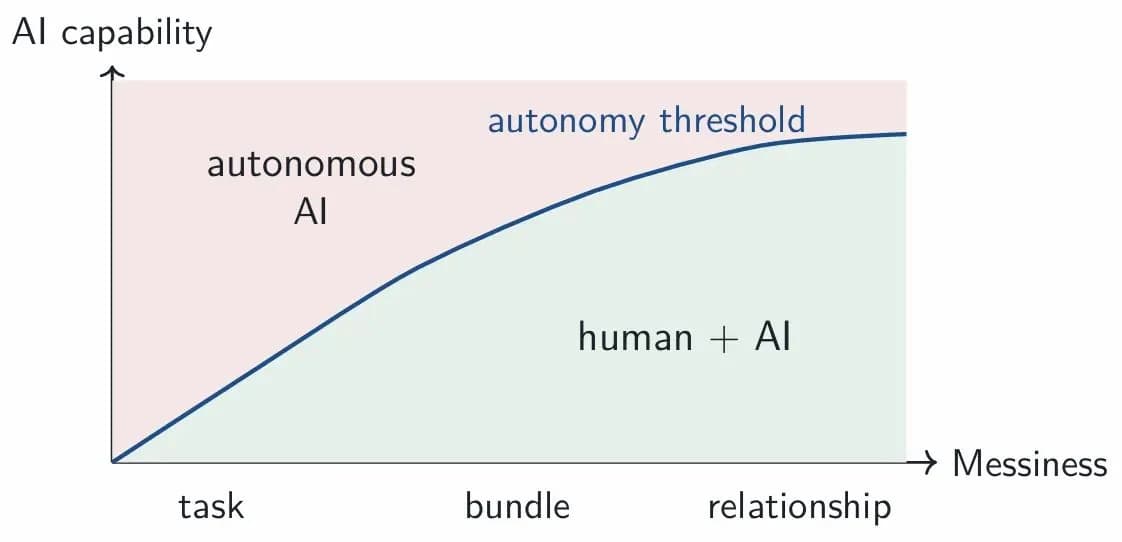
Which work faces displacement by AI first? Most people guess wrong. The intuition is that the most complex, best paid work is most at risk. The reality is more about how messy a job is.
Text, numbers and code are under pressure first
Jobs that produce text, numbers, or code without a person in the room are under pressure first.
That's the clearest takeaway from the AI Job Impact Map by Liminal Capital, which breaks down US occupations by AI substitution and complement. If your output is a document, a spreadsheet or a pull request, and nobody needs to be physically there to produce it, an AI agent can increasingly produce it too.
Physical work is safe, for now
Physical work still looks safe from AI agents. But that safety fades if humanoid robots become cheap and reliable enough for repeatable tasks in controlled spaces. A warehouse or a factory floor is a controlled space. A client's house with a leaking pipe is not.
The work more likely to last is mixed work, where a tool can help but a person still has to show up, judge the situation, and take responsibility.
Why messy jobs resist automation
Luis Garicano's insight that AI autonomy declines with job messiness reveals an important truth about which work faces displacement. It is routine, transactional roles that are vulnerable, not the complex relationship-driven work we assume is most at risk.
As tasks grow messier, AI capability stalls while human judgment becomes indispensable, drawing an autonomy threshold that protects messy work from replacement.
Exposure is not displacement
Exposure to AI may be highest for workers with the highest wages, but task exposure does not entail job displacement. The threshold increases with messiness, and messiness increases as tasks become bundled and jobs involve relationships.
That distinction matters. A job is not one task, it's a bundle of them. AI can take over several tasks in a bundle without taking over the job, as long as what's left requires judgment, context and other people.
Senior engineers already do the messy work
My own field is a good example. As software engineers grow more senior, their work shifts from writing code to helping people. Technical skills still matter, but success depends on leadership, communication, and guiding teams. A senior engineer spends less time on syntax and more time on alignment, mentorship, and unblocking others.
The Staff Engineer's Path by Tanya Reilly makes the same point: even if you choose not to become a manager, higher seniority still requires people skills. Staff engineers must lead without formal authority, drive large-scale technical strategies, and build consensus across multiple teams.
That's messy work. And it's exactly the part of engineering AI is least able to take over. The part of the job that AI does best, writing the code, was already the part senior people did less and less of.
What this means
If your work is mostly producing text, numbers or code on your own, the tools are coming for those tasks first. The way to stay valuable is to move toward the messy part: the people, the judgment, the responsibility. That has always been what seniority meant. AI just makes it urgent.
Further reading and sources
- AI Job Impact Map: US Occupations Broken Down by AI Substitution and Complement, Liminal Capital
- The mess is your moat, Apollo Global Management
- AI and Messy Jobs
- The Staff Engineer's Path, Tanya Reilly