2 min read
EU AI Act Article 50: How AI Text Watermarking Works and Why It's Mostly Useless
Anthropic signed the EU AI Act Article 50(2) Code of Practice on marking AI content. How text watermarks work, and why paraphrasing or translation erases them.
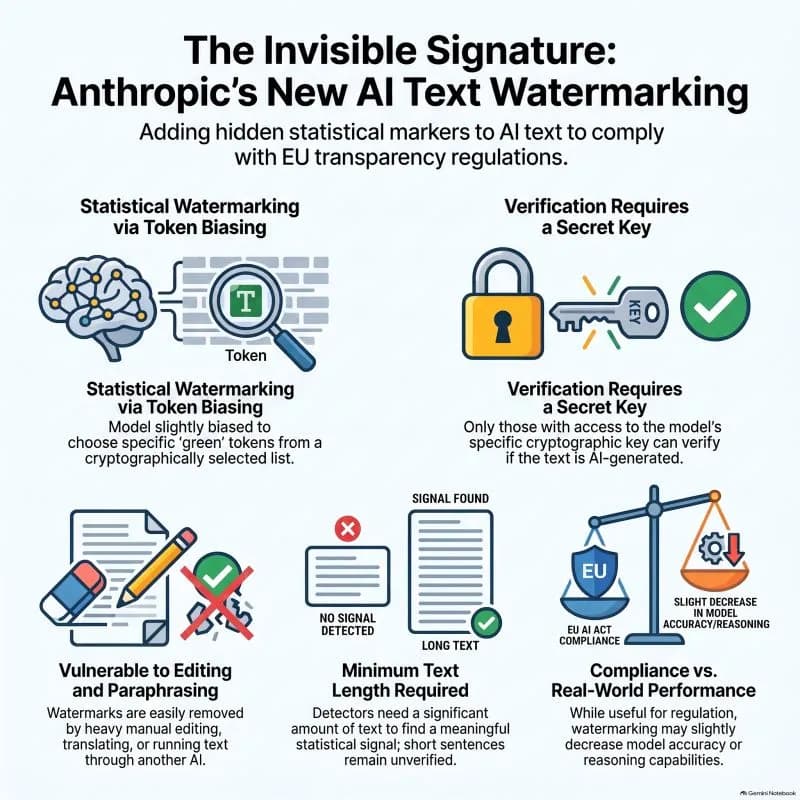
Anthropic has signed the EU AI Act's Article 50(2) Code of Practice on Transparency of AI‑Generated Content, as a provider of both generative AI models and generative AI systems (how Claude marks AI‑generated content).
New models will mark AI-generated content from day one. Marking works everywhere you use Claude.
Here's how it works, and why it's useless.
What Article 50 of the EU AI Act asks for
Article 50 is the transparency part of the EU AI Act. Among other things, it expects providers of generative AI to mark the content their systems produce, so that it can be detected as AI-generated. The Code of Practice is how providers like Anthropic commit to doing that in practice.
For text, that marking is a watermark.
How AI text watermarking works
When an AI writes, it is constantly choosing the next word. Often, there are two or three words that fit perfectly (like "happy" vs. "glad"). Instead of picking one at random, a secret code (a cryptographic key) tells the AI to slightly prefer a specific "green" word more often. To a human reader, the text looks normal because the words still make sense, but there is now a hidden statistical lean toward those "green" words.
How a watermark is detected
You cannot see this watermark just by looking at the text. To find it, you need a special detector and the original secret key used by the AI company. The detector checks the text to see if those specific "green" words appear way more often than they would by pure luck.
This only works on long pieces of text. A few short sentences don't provide enough data for a "guilty" verdict.
Why AI watermarks are mostly useless
Because this watermark is just a pattern of word choices, it is very fragile. You can "wash" the watermark out of the text in several ways:
- Paraphrasing: If you ask a different AI (like a local model on your computer) to rewrite the text, it will use its own word choices, erasing the original pattern.
- Heavy editing: If you manually change enough words or sentences yourself, the statistical pattern is broken.
- Translation: Moving the text into another language and then back again usually scrambles the "green" word pattern completely.
A small hurdle, not a permanent stamp
In short, while it helps companies follow new laws like the EU AI Act, it is more like a "small hurdle" than a permanent stamp. Anyone determined to hide that they used AI can simply "scrub" the text until the watermark disappears.