3 min read
I Asked the Smartest AI Models: What If We Ate 10% Less Meat?
I asked Gemini, Grok and Fable how a 10% cut in meat consumption affects health, money, the economy and the planet. Their answers, and what I learned from them.
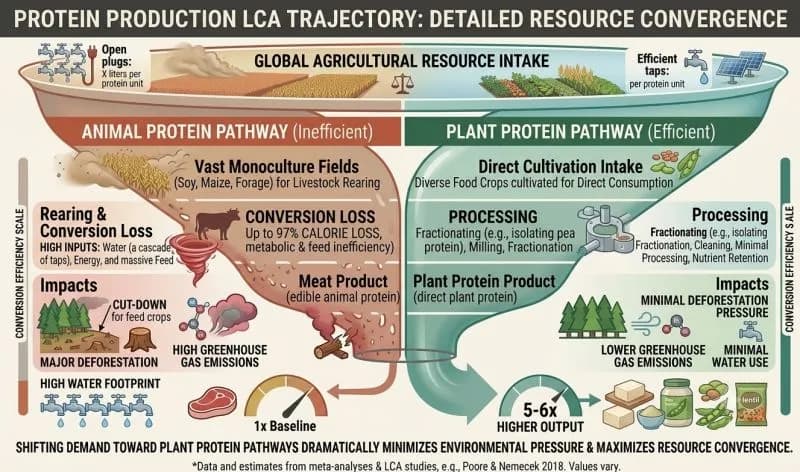
I've asked the smartest AI models: "How would a 10% reduction in meat consumption impact personal health, finance, the economy and the planet?"
Here's what they said.
Gemini 3.1 Pro
A 10% reduction in meat consumption significantly benefits the environment and the economy by lowering agricultural greenhouse gas emissions, conserving water, and reducing overall consumer food prices. On a personal level, shifting slightly away from red and processed meats improves diet quality and lowers the risk of chronic illnesses like heart disease. Additionally, replacing meat with plant-based alternatives directly reduces weekly grocery bills and contributes to massive global healthcare savings by decreasing diet-related medical costs.
Grok 4.5 Expert
Yes, a 10% reduction in meat consumption would have measurable impacts across personal health, personal finance, the economy, and the planet, though the effects are modest at this scale, vary by context (especially high- vs. low-consumption regions and what replaces the meat), and are stronger when focused on red/ruminant meat rather than poultry.
Fable 5 Max
A 10% cut in meat consumption yields small but real benefits for personal health (lower risk of colorectal cancer, heart disease, and diabetes, if replaced with legumes or whole grains) and modest grocery savings of maybe €5-15 a month. Economy-wide, the effect is redistributive rather than harmful: spending shifts to other food sectors, with concentrated losses for livestock farming offset by projected healthcare savings. The strongest case is environmental, since livestock drives roughly 12-15% of global emissions, and focusing the cut on beef and processed meat maximizes every one of these benefits.
How the answers compare
Same question, three different styles. Gemini gives the broad, confident picture. Grok is the most careful, and stresses that the effects at 10% are modest and depend on context. Fable is the most concrete, and puts actual ranges on the savings and the emissions.
What they agree on matters more than how they phrase it: the benefits are real, they're bigger when the cut focuses on red and processed meat, and the strongest case is environmental.
Some more interesting facts I learned
- Diet quality: A study from Tulane University found that simply swapping beef for chicken or plant-based alternatives just a few times a week can improve overall diet quality by 4-10% while cutting a person's dietary carbon footprint by up to 35%.
- Disease prevention: Small but consistent reductions in red and processed meats are strongly correlated with a lower risk of heart disease, type 2 diabetes, and certain cancers.
- Healthcare savings: Overconsumption of meat contributes heavily to diet-related diseases. Estimates suggest that if global populations shifted closer to recommended plant-forward dietary guidelines, the world could save up to $735 billion a year in reduced health-related costs.
- Greenhouse gases: According to simulations by the OECD and the UN Food and Agriculture Organization (FAO), a 10% global reduction in ruminant meat consumption (like beef and lamb) could lead to a 15% reduction in agricultural emissions.
Why ask AI models questions like this
That's why I like asking several models the same question. Not to get one answer, but to see where they agree, where they hedge, and which facts are worth looking into further. For questions that touch health, money, the economy and the planet at once, that's a better starting point than any single opinion.